

Communion with the ball
Marty Reisman's life gambling, smuggling, and playing ping pong

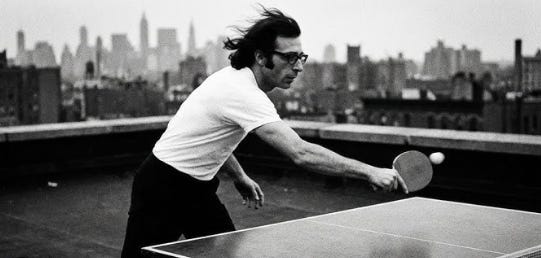
I finally made it out to see Marty Supreme, and I wasn’t disappointed. It’s an incredible film. The set pieces and costumes are captivating. The dialogue is fast and fun. The story is, well, a bit of a shaggy dog (literally) but honestly in the best Coen brothers sense of the term. The cast is an absolute fever dream of New York City real life freaks and nutjobs. Best of all, the movie is a paean to gambling.
The film has an extended sequence of Timothy Chalamet and Tyler the Creator’s characters hitting the road to hustle ping pong that is very much reminescent of The Color of Money, but that’s not the only gambling that takes place in the story. Surely Marty’s entire life is a gamble, with him increasingly pressing his bets and raising the stakes to try to run a single winning streak into something transcendent that might take him away from his humdrum life in NYC’s Lower East Side.
I plan to talk about all of this on Thursday at 2pm EST on Substack Live with my friend Ursula Lawrence. You may remember her from the episode of the Book Club we did on David Milch’s Life’s Work. If you didn’t catch that, you can listen to it here:

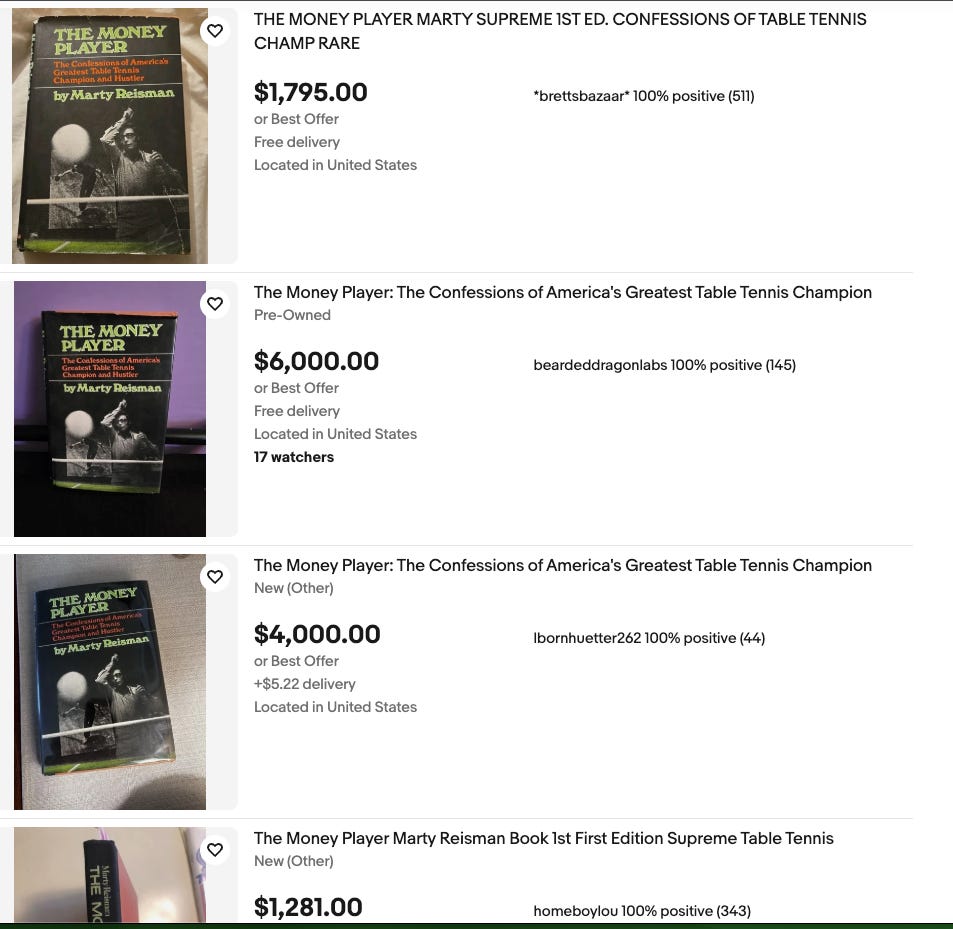
But while Marty Supreme may only show Marty hustling ping pong during one section of the movie, the real life Marty Supreme, Marty Reisman, hustled all the time. He made most of his living most of his life as a gambler, a hustler, and at times a smuggler. He wrote a memoir in 1974 titled The Money Player that detailed his life of gambling on ping pong all over the world. (Copies of the long out of print book are now selling for thousands of dollars on ebay thanks to the success of the film)
Marty Reisman was born in 1930 on the Lower East Side to a gambler named Morris Reisman. Morris was also a taxi driver who once owned his own fleet of cabs but lost them all in a poker game.
Marty says he began gambling at the age of twelve, playing $10 a match ping pong with a hustler named Larry Quinn, who Reisman called “a vampire” who would hustle children and force them to sleep with him to pay off their debts.
By the time Reisman was 13 he was working Lawrence’s Broadway Table Tennis Club under the tutelage of a bookmaker from Detroit. He’d introduce Reisman as his nephew “Jackson,” and Reisman would sometimes win, sometimes lose, depending on what the bet was. Once Reisman’s dad showed up at Lawrence’s and placed a $50 bet on Marty, but the match was fixed and Marty was supposed to take a dive. Afterwards Marty paid his dad the money back and told him what had happened, and his father lectured him about dumping. Marty resolved to never do it again.
On Friday nights in the 1940s Lawrence’s would have tournaments that would bring in players from far and wide. Marty competed in the tournaments, but made most of his money in side games and in side bets he placed on himself. The table tennis scene was really no different than the pool hall scene. You negotiated a spot with someone, some number of points to give them as a handicap, and you’d play for money.
But while ping pong was largely a subterranean affair in the United States, it was booming around the world. Some people said it was the second largest sport behind soccer, largely because of its popularity across Asia. By the late 40s, Marty was traveling the world to play in tournaments.
In the film these trips are paid for by an increasingly outrageous series of scams and hustles, but in real life Marty paid his way by smuggling. For years Marty and Doug Cartland traveled the world with the Harlem Globetrotters as a halftime act, doing ping pong stunts or playing ridiculous matches against each other. (Reisman says the Globetrotters were all huge gamblers who would bet tons of money on their matches and stick around through halftime to sweat their bets) He was able to travel back and forth to events on US Military planes which didn’t go through customs, and he took advantage. He smuggled everything from nylon stockings to ball point pens to fine china. Eventually as his career progressed he moved up to gold bars, smuggling them back and forth across Asia for thousands of dollars.
The 1952 tournament depicted in the film is based on a real one - the world championships in Bombay. There Reisman came across a Japanese player named Hiroj Satoh who played with a paddle unlike anything the Americans had ever seen before. Satoh defeated his opponents by humiliatingly large margins, including Reisman, and was crowned the world champion. Reisman and his friend Doug Cartland hustled their way from Bombay across Asia to Tokyo, gambling and playing exhibitions wherever they could. Once they arrived they challenged Satoh and Nobi Hayashi to a doubles match, a US-Japan exhibition that would be sponsored by a ball manufacturer. 5,000 people watched live and the match was broadcast nationally on the radio. It was ultimately decided in a singles match between Reisman and Satoh, which Reisman won. Satoh never recovered from the loss. He never again showed up in international play.
From there the two Americans traveled the world, now living off of the sales of their signature ping pong balls as well as their gambling profits. They performed exhibitions for heads of state - like Governor Sergio Osmena Jr. of the Phillipines, who invited Reisman to play him for money - with a handicap of course.
But the game that really got to Sergio took place in Manila near the end of my stay in the Philippines. It involved placing a small wooden matchbox upright on his forehand side, some six inches from the edge of the table. There was no spot in the game. He could score points in any of the recognized legal ways. The only way I could score was to hit the matchbox with the ball and knock it off the table. I won the first several games and Sergio could not believe what was happening to him. He kept increasing the bets, unaware that what I was doing was similar to the stunt I used to give during the halftime of Globe Trotter games: knocking a cigarette off the end of the table; not only knocking it off, but breaking it in half.
I was $2,500 ahead and Sergio could not accept it. He bet me $1,000 and I won again. He offered to bet $2,000. At this point Judge Augusto Luciano, head of the Philippines Table Tennis Association, stepped in. Luciano had been watching the games and he had seen enough. He called me aside.
“Governor Osmena can afford to lose,” said Luciano, “but I really wish you would stop. He is a patron of table tennis here and it would prove embarrassing if he lost an extraordinary amount of money.”
I saw Luciano’s point. Besides, take a little, leave a little, had for a long time been my philosophy. Also, I reasoned, there would be other trips to the Philippines.
Reisman won the national championship in 1958 and bought a club in NYC called the Riverside Table Tennis Club. By the 1960s he had virtually retired from international tournament play. He had a nervous breakdown in 1961 that led to acute anxiety, but he also felt the game had changed too much technologically and was passing him by. The rubber rackets were being replaced by the spongy bats he encountered in Bombay from Satoh. He explained it to Sports Illustrated this way:
"To play with the hard rubber racket is to be in communion with the ball," says Reisman. "Unlike the sponge, it lets you experience each stroke, each vibration, until the tone and feel of the racket become part of your neurological system.”
"What they call a technological advance is really a setback for the spectator," Reisman says. "In the pre-sponge era the ball crossed the net an average of 30 times on each point. The strategy, the entrapments, the players, could be understood and enjoyed by everyone. Today the ball rarely crosses the net more than four times. Points are scored with contorted strokes and imperceptible twists of the wrists that defy appreciation. Table tennis used to have an esthetic quality about it. Now everything is based on confusing your opponent. They've turned a sport into a game."
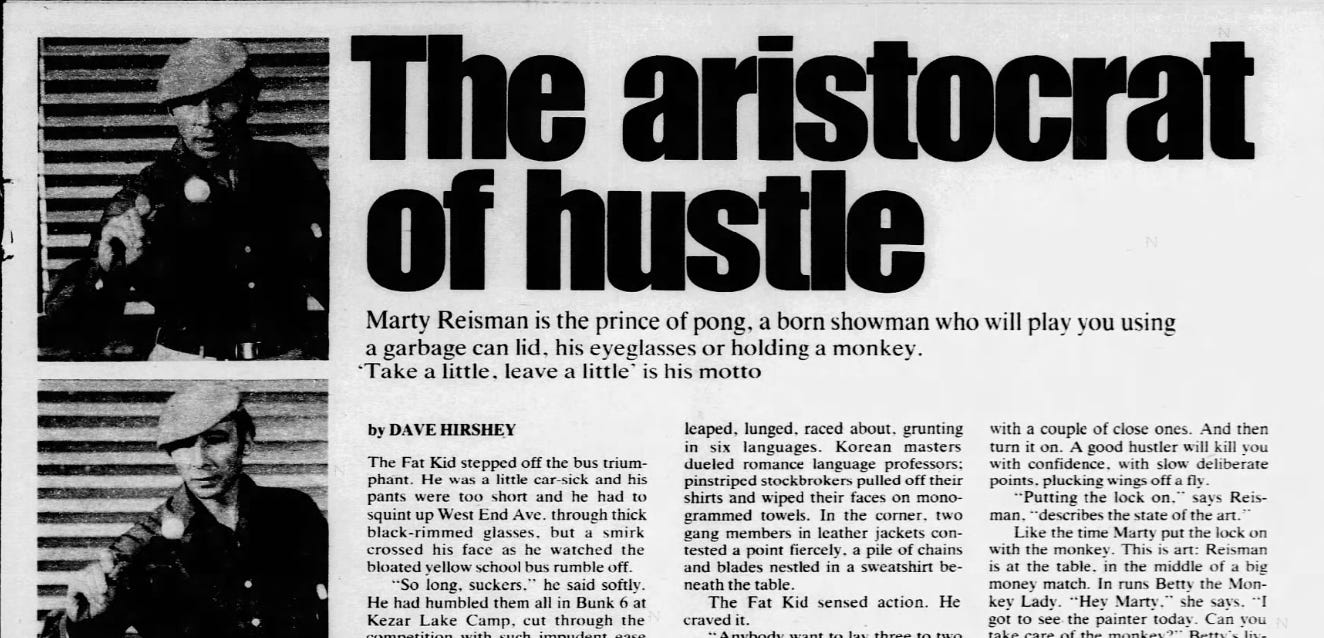
For many years Reisman continued to hold court at his and other table tennis clubs in NYC. He was a curiosity, a tall tale. In 1980 Games Magazine sent a writer to meet him and ended up playing him in a match where Reisman had to sit in a chair the entire time. In 2003 the New Yorker sent a writer to accompany him to Las Vegas for the national championships. In 2008 he appeared on David Letterman with Matthew Broderick to do his famous cigarette trick.
In 2012 Marty Reisman passed away from heart complications. He was 82 years old. The things he had seen and done in his long life are barely done justice by this short survey or even the truly epic film Marty Supreme. He turned ping pong (and gambling) into a life of adventure and fortune - something that took him around the world and into palaces and presidential suites, from war zones to the pyramids. It took him from the slums of the lower east side to the highest most rarified places. But only because he didn’t just rely on his skill as a player - he got there with his hustler’s heart.
If you’d like to hear Ursula and I talk more about Marty Supreme, head over to davidhill.substack.com on Thursday at 2pm EST and join us, and leave your own questions or comments about Marty Supreme (or Marty Reisman) in the chat!
Waiting to read this until after I see the movie. I’m sure it’s great.
Mr. Reisman sounds amazing from your intro. Could of been a series, then they would have had time to develop the 'hustlers heart' and explore how and why "each stroke, each vibration, until the tone and feel of the racket become part of your neurological system."
I thought they tried to pack too much in and the film was scattered. But what do I know. Now I want to read the book.